
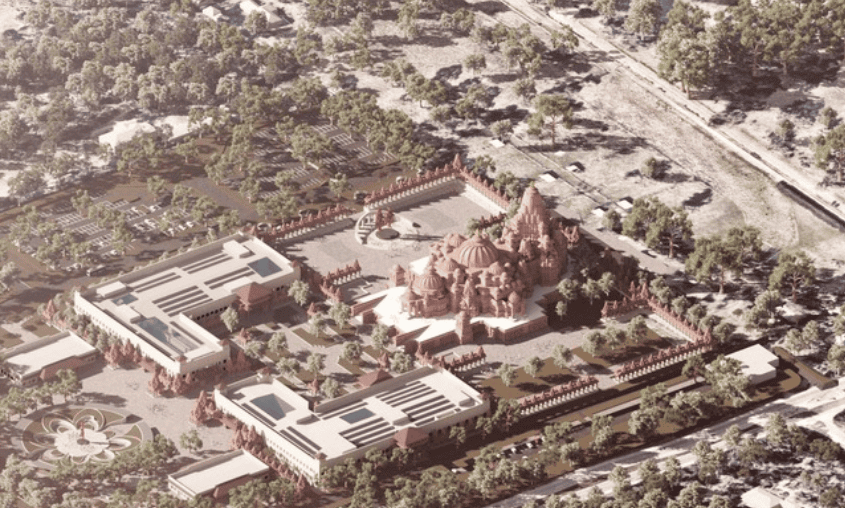
A $190 million Hindu temple complex, including a main building reaching 64 metres in height, has been proposed for a 42-hectare green wedge site in Cranbourne South.
BAPS Swaminarayan Sanstha Australia is seeking approval to build the BAPS Hindu Mahā-Mandir at 1390–1450 Western Port Highway, near Homewood Road.
The proposal is being assessed by the State Government through its Development Facilitation Program (DFP) for significant economic developments, with the application now open for public feedback.
BAPS says Melbourne’s rapidly growing Hindu population, including a large and expanding Indian community in Casey, has outgrown the limited number of purpose-built venues capable of accommodating daily worship, religious education, community activities and major festivals.
At the centre of the development would be a traditional stone Hindu temple, surrounded by four supporting buildings containing prayer halls, religious education areas, administration offices, kitchens, visitor facilities and accommodation for resident and visiting religious practitioners.
The main temple would rise approximately 64 metres, excluding its flagstaff, while the supporting buildings would range from nine to 23 metres.
Public visiting hours are proposed between 7am and 8pm daily, with extended or altered hours possible during religious festivals.
Planning documents estimate the site would attract between 2200 and 2800 visitors each weekday and 4500 to 5000 each weekend.
Attendance could rise to between 9500 and 10,500 visitors a day during major religious festivals and special holidays.
Up to 3600 people could be present at one time during nine ‘top-tier’ events each year, with another eight ‘middle-tier’ events expected to attract up to 2400 people at once.
The development proposes 642 formal parking spaces, 450 overflow spaces and five bus bays.
Two entrances would be provided from Homewood Road, while a left-in, left-out entrance would be constructed on Western Port Highway.
As part of its proposal, the applicant would deliver a new roundabout at Western Port Highway and Homewood Road and seal Homewood Road along the site frontage to a minimum width of seven metres, subject to DTP approval and planning-permit conditions.
Traffic modelling commissioned by the applicant concluded the surrounding network could accommodate the development, although the Homewood Road approach to the new roundabout could approach capacity during major events under higher-traffic modelling.
Major events would be subject to a traffic management plan, potentially involving temporary speed reductions, variable-message signs, parking restrictions, traffic controllers and measures to prevent queues extending onto Western Port Highway.
The approximately seven-year construction project is expected to support an average of 110 direct and indirect jobs annually, according to an economic assessment submitted with the application.
BAPS volunteer Yash Patel said the organisation wanted to create a spiritual home for Australian Hindus that would also welcome the wider community.
“We are part of this community. Our families live, work, study and volunteer here, and we want the Mahā-Mandir to be a place that contributes to the community we all share,” he said.
The site sits within the Western Port Green Wedge.
The applicant argues the development is appropriate because the property sits in the Casey Urban Growth Boundary Interface Precinct, where urban Cranbourne meets the Green Wedge.
Its planning report describes the location as a transitional setting with direct access to Western Port Highway and separation from established residential areas.
BAPS says buildings would cover about six per cent of the land, while more than 90 per cent would remain open space, landscaping, circulation areas or habitat.
However, the proposal would require the removal of 1.718 hectares of native vegetation, including 31 scattered trees.
Biodiversity offsets and revegetation are proposed.
BAPS says the plans were revised to avoid all confirmed Glossy Grass Skink habitat and retain about 90 per cent of native trees identified as having high retention value.
No formal bicycle parking is proposed, despite the planning assessment identifying a statutory requirement for 62 spaces.
The applicant argues cycling demand would be low because of the site’s remote location and lack of nearby cycling infrastructure.
Commenting on the previous $250 million plans in December 2025, Casey Residents and Ratepayers Association president Anthony Tassone said opponents did not object to the Hindu faith or the need for places of worship, but questioned whether a development of this intensity belonged in the Green Wedge.
“Those visitation levels are comparable to a major metropolitan destination,” he said.
“Local residents are understandably concerned about what that means for traffic, noise, lighting, environmental disturbance and the gradual urbanisation of land that is meant to remain non-urban.”
A Federal Environmental Referral was subsequently withdrawn for redesign, and the current application reduces the estimated project cost from $250 million to $190 million and includes changes intended to avoid confirmed Glossy Grass Skink habitat and reduce the development footprint.
BAPS encouraged residents to examine the plans and provide feedback through the formal planning process.
To submit your feedback, visit: planning.vic.gov.au/planning-approvals/ministerial-permits-register/ministerial-permits/0051c637-ac76-f111-ab0f-7c1e522a8afb
Source: Star Berwick